Skip to the content


Sensory and emotional balancing: the role of the senses in how you calm down

Sensory is the way the nervous system receives, filters, and responds to stimuli from the surroundings and from within one's own body: light, sound, smell, taste, touch, movement. Every person has several channels through which they feel more intensely and through which, often without knowing it, they seek peace. When you know them, you can use them as a resource for emotional balancing, not just on autopilot.
Each sense has a different threshold: some react quickly and become saturated quickly, others need more stimulation. Winnie Dunn described four ways of responding to stimuli, and Daniel Siegel appointed tolerance window the area where we can feel without being overwhelmed. Chosen, measured and predictable stimuli can help the nervous system to come down from alert. This idea is based on Sensory Care: a sensory pattern test and six evenings Harmony Thursday with a psychologist.
What is sensory?
Two people enter the same room and have two different experiences. One notices the light being too cold, another the background noise, another the smell of coffee. These differences are not whims. They are due to neurological thresholds each one: how much stimulus a sense needs to react.
From these thresholds, a personal style is born: how you learn, how you approach people, and, most importantly, how you calm down when things get tough. Why an open-space makes you tired or why a hot shower fixes a bad day: the answer is often sensory.
The six sensory channels
The Sensorial Care program works with six channels: the five known senses and kinesthetic, which brings together the sense of movement, balance and body position (proprioception).
| Channel | What do you notice first? | What usually calms you down? | When it becomes excessive |
|---|---|---|---|
| Visual | the light, the order, the details | the warm light, the gaze into the distance, the moving water | endless scrolling on phone |
| aural | tone of voice, rhythm, noise | slow music, sounds of nature, chosen silence | the constant background noise, so you don't stay in silence |
| Olfactory | the air, the atmosphere | the warm aromas, the fresh air, the steam | refuge smells: cigarette, excess coffee |
| gustatory | the taste, the texture, the ritual of the meal | hot drinks, slow eating | eating without hunger, under stress |
| Tactile | materials, temperature, touch | heat, deep pressure, hot water | compulsive comfort seeking or avoidance of touch |
| kinesthetic | movement, body position | rhythmic walking, stretching, hot-cold alternation | sports to exhaustion, the weight of stopping |
Synthesis based on the material from the Sensorial Care program (DepreHUB). Every person has them all; the order and intensity differ.
Four ways to respond to stimuli
The most widely used model for these differences belongs to the occupational therapist. Winnie Dunn (1997). He combines neurological threshold (low or high) with response strategy: passive, when you stay in the situation, or active, when you change something around.
You need more stimulation to feel enough: you move, you taste, you turn up the music. The risk is excess.
You get fed up quickly and control your environment: you close the door, you leave. The risk is isolation.
You notice everything, but you stay and endure. The risk is the fatigue accumulated in silence.
You notice hunger, fatigue, tension late. The risk is that you find out too late that you are at the limit.
No one has a single pattern: you can be intensely searching for movement and at the same time be very sensitive to noise. For adults, the pattern has become a standardized tool, Adolescent/Adult Sensory Profile (Brown and Dunn, 2002). Separately, Elaine and Arthur Aron described in 1997 sensory processing sensitivity, a trait that Elaine Aron estimates to be present in about 15–20% of people.
What connects senses to emotions?
Three lines of research show how close the senses are to emotions:
- Interoception. The body also has an inward-facing sense: breathing, heartbeat, blood pressure, hunger. Researcher AD Craig proposed in 2002 that this map of the body's state could underlie subjective feelings and emotions.
- The smell. Its signals reach the amygdala, a central structure for emotions, without the relay of the thalamus, through which the other senses pass (Kadohisa, 2013). And Rachel Herz found in 2004 that memories evoked by smells are experienced more emotionally than those evoked by images, sounds or words.
- Slow touch. The skin has specialized fibers for affective touch, called C-tactiles. They respond most strongly to slow stroking, 1–10 centimeters per second, which is precisely what is described as the most pleasant (Löken et al., 2009), and send the signal to the insula, the area that links body state to emotion (Olausson et al., 2002).
The same sense that becomes saturated can also calm down, if it receives the right stimulus, in the right dose. Balancing does not mean eliminating stimuli, but choosing them.
Yolanda Crețescu
Tolerance window
psychiatrist Daniel Siegel, a clinical professor at UCLA, described in 1999, in The Developing Mind, tolerance window: the activation range in which we can feel intensely without being overwhelmed and can respond, not just react.
Above her is hyperactivation: agitation, restlessness, thoughts that don't stop. Underneath is hypoactivation: numbness, emptiness, exhaustion. The window narrows when we are tired or overstimulated.
This is where the senses come in. For many people, warm light, a long sound, or warmth descend activation, and fresh air or movement elevate. What works differs from person to person: that's exactly what the sensory pattern shows.
When one sense carries all the weight
Each dominant sense is a resource. The difficulty arises when a single channel carries all the burden of calming down, day after day: the phone call after a hard day, the evening snack without hunger, the agitation that doesn't stop. The difference between ritual and excess is usually, dose and intention. You don't give up your channel, you add another one. Three exercises in the program:
- Slow gaze (visual): five minutes with a single source of warm light, looking at a plant, a candle, or the sky.
- Olfactory anchor (olfactory): a scent used only in moments of calm; when tension arises, three slow breaths with it.
- 90-second break (taste): before the stress snack, the question "am I hungry or am I feeling heavy?" and a warm drink.
From an Adlerian perspective, the symptom has a meaning: it is an attempt to cope. Stress eating or constant agitation are, at first, solutions. We work to make them become choices.
Yolanda Crețescu
From Snoezelen to The Elements rooms
In the late 1970s, two Dutch therapists, Jan Hulsegge and Ad Verheul, have set up an environment with lights, sounds, textures and smells for people with severe disabilities at the De Hartenberg Institute. They called it Snoezelen, from sniff (to sniff) and doze off (to nap). The first permanent room opened in 1982, and the idea then spread to schools, hospitals, and nursing homes.
The principle: when stimuli are chosen, dosed and predictable, the nervous system no longer has to stand guard. The Elements is not a clinical space, but a spa, but its rooms follow the same logic, and in Sensorial Care we read them according to the senses they nourish:
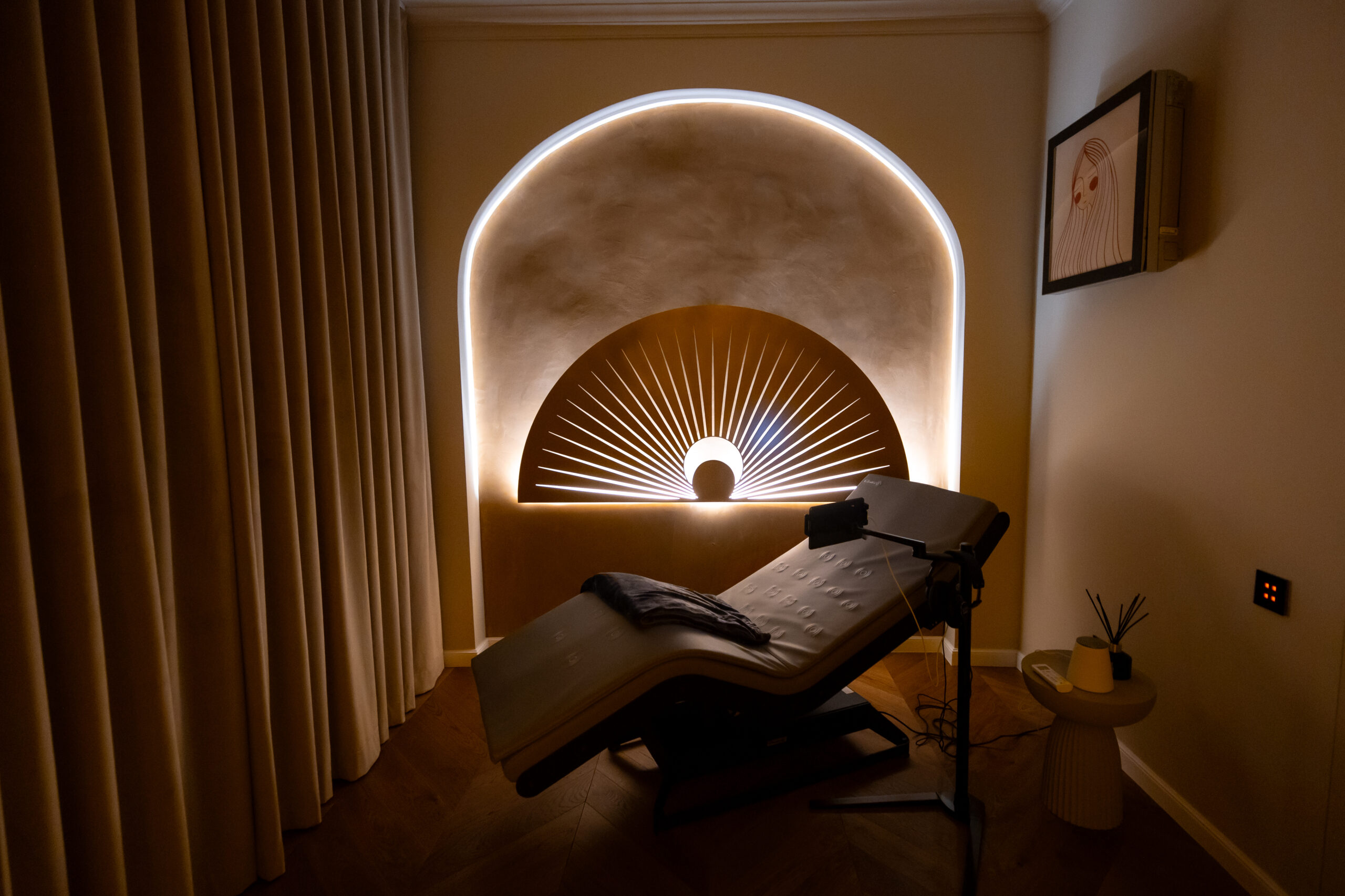
- Fire Chamber: fireplace, warm atmosphere, binaural frequencies. auditorvisualtactile
- Water Room: fountain where water flows upwards, diffused blue light, private jacuzzi. visualauditortactile
- Earth Room: quartz-heated beds, for those who carry a lot on their shoulders. tactilekinesthetic
- sanctuary: dry sauna, steam sauna, emotional shower, jacuzzi. olfactorykinesthetictactile
- Vichy Room: rhythmically moving jets of warm water, chromotherapy, heated Himalayan salt, no conversation. tactilekinestheticvisual
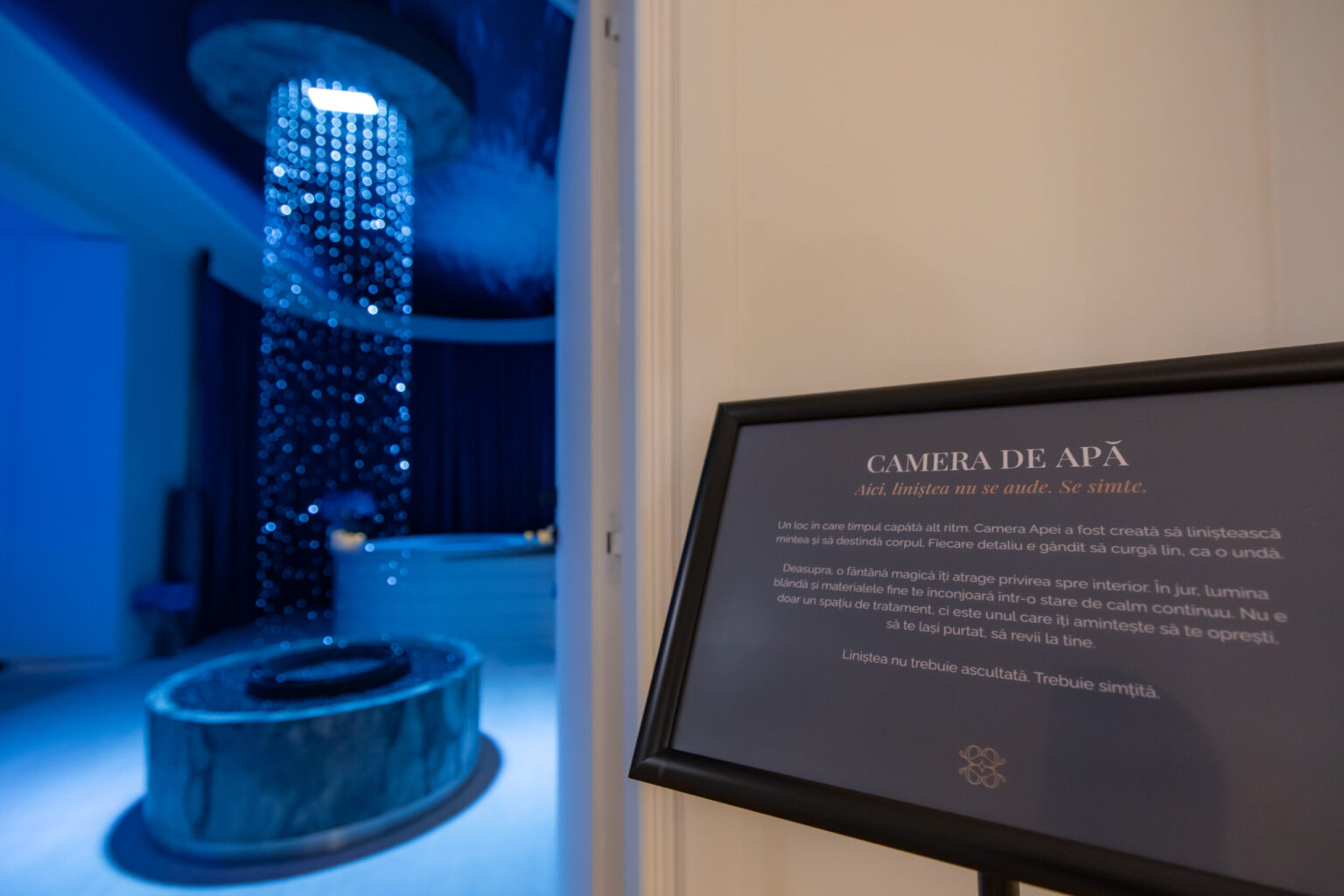
The goal is not a generic treat, but to recognize, over time, what stimulus you need and be able to recreate it at home. For touch, guide on how to choose the type of massage explains the differences in pressure and rhythm between techniques.
Sensory Care Test and Harmony Thursday evenings
Test: 54 statements, approximately 10 minutes
test Sensory Care was built by Yolanda Crețescu (DepreHUB): 54 statements, nine per sense, in six steps. In addition to the dominance of each channel, it follows three dimensions inspired by Dunn's model: interest (how much you seek stimuli), discrimination (how finely you distinguish shades) and modulation (how proportionately you react).
The result is a code of the form SC-XY, after the first two senses, a profile, excess signals and a balancing plan for 12 weeks, with The Elements rooms and treatments. Scoring is done in the browser: answers do not leave your device.
The Sensory Care Test is a guiding tool for self-knowledge. It is not a standardized psychological test and does not make diagnoses. It does not replace specialist evaluation or treatment.
Harmony Thursday: six evenings with a psychologist
The first step in each plan is to discuss the outcome at one of the evenings. Harmony Thursday: group meetings, Thursday, 7:30–9:30 PM, in The Elements lobby, with a maximum of 10 participants. Each evening has a sensory check-in, psychoeducation, an experiential exercise with elements of theatrical pedagogy, and a practice for the following week.
| Thursday | Theme of the evening | Recommended when dominant |
|---|---|---|
| Oct 15 | Stress and burnout | kinesthetic |
| Oct 22 | Resistance to change | olfactive |
| Oct 29 | Anxiety and hypervigilance | auditory |
| Nov 5 | Emotional hunger | gustatory |
| Nov 12 | Sleep and recovery | visual |
| Nov 19 | Sensory relationships and boundaries | tactile |
Each evening is booked separately. The test is not a condition of participation, but it shows you which evenings are suitable for you.
Frequently asked questions
What is sensory?
The way the nervous system receives, filters, and responds to stimuli from the environment and from within one's own body. Every person has several dominant senses, through which they perceive more intensely and through which they seek peace.
What are the four patterns of sensory processing?
According to Winnie Dunn's model (1997): sensory seeking, sensory avoidance, sensory sensitivity and low registration. They combine neurological threshold (low or high) with response strategy (active or passive).
What is the tolerance window?
A concept described by psychiatrist Daniel Siegel in 1999: the range of activation within which we can feel without being overwhelmed. Above is hyperactivation (agitation, restlessness), below is hypoactivation (numbness, exhaustion).
What is a Snoezelen sensory room?
A space where light, sound, temperature, texture and smell are chosen and dosed. The concept was created in the Netherlands, in the late 1970s, by Jan Hulsegge and Ad Verheul.
Sensory Test What is a psychological test?
No. It is a self-awareness tool. It is not standardized, does not diagnose, and does not replace professional evaluation or treatment.
What happens on a Harmony Thursday night?
A two-hour group meeting, with a maximum of 10 participants, led by clinical psychologist Yolanda Crețescu, on Thursdays, between October 15 and November 19, 2026, in the lobby of The Elements. The test is not mandatory, but it shows you which evenings are suitable for you.
source
- Dunn, W. (1997). The impact of sensory processing abilities on the daily lives of young children and their families: A conceptual model. Infants & Young Children, 9(4), 23–35.
- Brown, C. and Dunn, W. (2002). Adolescent/Adult Sensory Profile. The Psychological Corporation.
- Aron, EN and Aron, A. (1997). Sensory-processing sensitivity and its relation to introversion and emotionality. Journal of Personality and Social Psychology, 73(2), 345–368.
- Craig, AD (2002). How do you feel? Interoception: the sense of the physiological condition of the body. Nature Reviews Neuroscience, 3(8), 655–666.
- Kadohisa, M. (2013). Effects of odor on emotion, with implications. Frontiers in Systems Neuroscience, 7, 66.
- Herz, RS (2004). A naturalistic analysis of autobiographical memories triggered by olfactory, visual and auditory stimuli. Chemical Senses, 29(3), 217–224.
- Olausson, H. et al. (2002). Unmyelinated tactile afferents signal touch and project to the insular cortex. Nature Neuroscience, 5, 900–904.
- Löken, LS et al. (2009). Coding of pleasant touch by unmyelinated afferents in humans. Nature Neuroscience, 12, 547–548.
- Siegel, D.J. (1999). The Developing Mind. Guilford Press.
- Hulsegge, J. and Verheul, A. (1987). Snoezelen: Another World. Break up.
See also
Sensory Care
Find out which senses calm you down
Ten minutes, 54 affirmations, and a balancing plan built on your template. Then you can discuss it with a psychologist, at Harmony Thursday.
Pipera Boulevard 86–88, Voluntari (Bucharest) · +40 735 363 687 · daily 10:00–21:00